

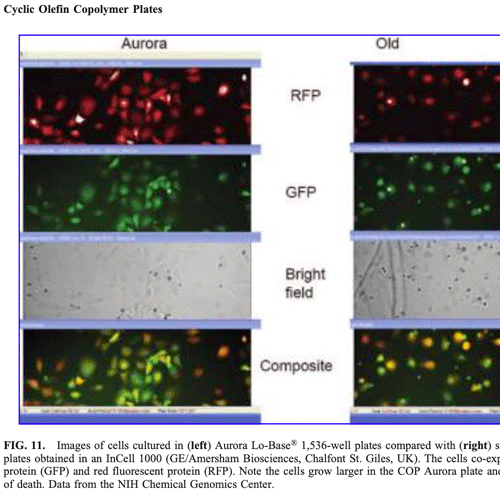
This peer-reviewed technology review from Assay and Drug Development Technologies (2008) examines the physical, chemical, and biological properties of cyclic olefin polymer (COP) as a microplate material for high-throughput and ultra-high-throughput screening. The authors compare COP directly against polystyrene and other plastics across mechanical stability, optical performance, biocompatibility, and sample storage — making the case for COP as the superior material standard for high-density multiwell formats.
Key findings:
- COP contains significantly lower residual metal catalyst than polystyrene (1 ppm vs. 150 ppm) — reducing risk of biological sample contamination in sensitive assays
- COP transmits UV through infrared wavelengths at near-glass quality, with substantially lower autofluorescence than polystyrene across visible emission wavelengths
- Plate flatness tolerances of 130µm overall and 13µm for fine features enable precise liquid dispensing and optical read positioning in high-density formats
- Cell-based assays miniaturized from 384-well polystyrene to 3,456-well COP plates showed improved Z-factor (0.67 → 0.96) and better dose-response regression
- COP’s low water vapor permeability and evaporation control well design maintained sample volumes within 1.18% change over 10 days
- Cells recognized as difficult to culture in standard plasticware proliferated successfully in COP wells with minimal surface preparation