

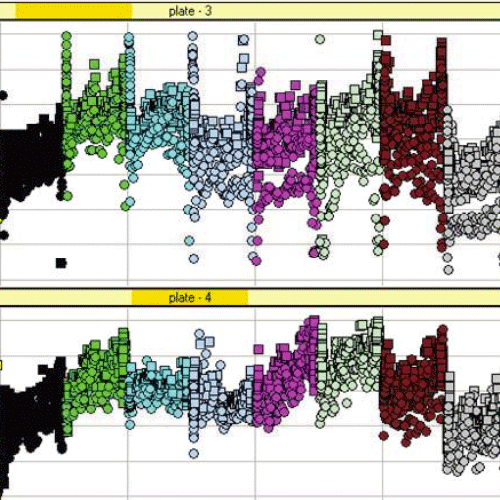
This peer-reviewed study from Pfizer Global Research and Development examines evaporation patterns and optimal storage conditions for DMSO nanospots preplated in COP-based ChemLib 1,536- and 3,456-well assay-ready plates. Using a cytochrome P450 3A4 fluorogenic assay as a sensitive DMSO indicator, researchers tracked evaporation-driven edge effects across seven storage conditions over 12 months — identifying best practices for long-term compound library storage in high-density COP microplates.
Key findings:
- Storage at -80°C in a bag, with or without filled evaporation wells, preserved DMSO nanospots with no detectable edge evaporation across the full 12-month study period in both plate formats
- Storage at -20°C with a bag and filled evaporation wells extended usable plate life to 7 months (1,536-well) and 12 months (3,456-well)
- Filling evaporation wells consistently outperformed bagging alone — plates stored with a bag but without filled evaporation wells degraded faster than plates with filled evaporation wells but no bag
- 3,456-well plates showed equal or better storage stability than 1,536-well plates under comparable conditions — an unexpected advantage of higher-density miniaturization
- Edge evaporation proceeded from outermost to innermost wells, meaning perimeter wells are the earliest and most reliable indicator of plate degradation