

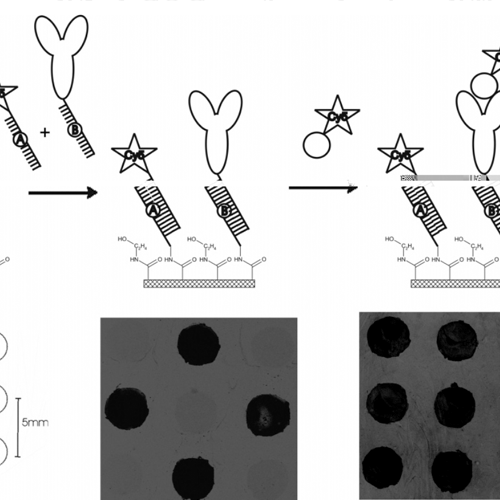
This peer-reviewed study from Dublin City University, published in Analytical Chemistry (2007), demonstrates successful immobilization of DNA and antibodies onto Zeonor cyclo olefin polymer substrates. Researchers developed a polyelectrolyte coating protocol that produces stable, wash-resistant biosensor surfaces — enabling Zeonor to function as a substrate for both DNA and protein microarrays in biodiagnostic applications.
Key findings:
- Zeonor substrates coated with poly(acrylic acid) via polyelectrolyte layering achieved stable, hydrophilic surfaces suitable for biomolecule immobilization
- DNA hybridization efficiency on PAC-coated Zeonor was comparable to glass reference slides
- Antibody immobilization via DNA-directed methods demonstrated sequence-specific protein placement with low nonspecific binding
- PAC-coated slides remained stable for up to one month under dry storage; DNA-functionalized surfaces held activity for several weeks
- Zeonor’s low autofluorescence and high optical clarity make it well-suited for fluorescence-based biosensor and microarray applications
Read the full paper for complete methods, surface characterization data, and fluorescence results.