

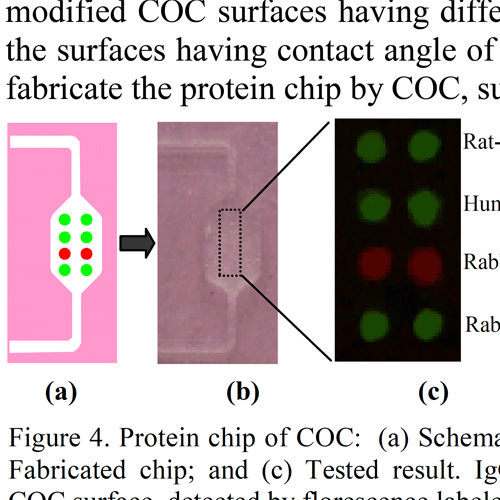
This conference paper from researchers at the University of Cincinnati’s Microsystems & BioMEMS Lab investigates protein adsorption behavior on cyclic olefin copolymer (COC) surfaces as a foundation for protein biochip development. The study examines how plasma-based surface modification affects IgG adsorption and evaluates COC’s optical transparency for both front and rear-side fluorescence detection — positioning COP as a viable alternative to glass, silicon, and metal in proteomics applications.
Key findings:
- IgG adsorption on COC surfaces varies predictably with contact angle — optimal adsorption observed at contact angles between 70° and 95°
- Plasma surface modification using O₂, N₂, and CF₄ gases enables controlled tuning of COC surface wettability for targeted protein binding
- COC’s high optical transparency enabled comparable fluorescence detection intensity from both front and rear sides of the substrate
- Results demonstrate feasibility of COC as a protein chip substrate for fluorescence-based immunoassay detection
- COC optical transmittance outperformed polycarbonate and PMMA across measured wavelengths